
December 21, 2025
Retention
Why Retention Testing Doesn’t Scale
Scaling retention isn’t “run more tests.” It’s increase experiments per segment without increasing risk or workload—and most teams are built for the opposite.
Author:
Justin Kunimoto
You can have a great lifecycle team and still cap out at a handful of experiments per quarter. Then you call it “prioritization” to feel better about it. Caveat: if you’re early-stage and still fixing basic measurement and messaging, you can scale later—just don’t pretend the ceiling isn’t coming.
Here’s the uncomfortable truth: retention testing doesn’t fail because you lack ideas. It fails because your org hits three bottlenecks, and each one turns “more testing” into organizational slapstick.
Brief context
Retention is getting harder, not easier: more segments, more channels, more scrutiny, and less appetite for “we’ll learn by shipping it.” The common but flawed approach is piling on dashboards and ad-hoc brainstorming while ignoring the system that turns ideas into repeatable learning.
In this piece:
What “scale” actually means in retention experimentation
The three bottlenecks that cap your test volume
The false solutions that waste quarters
What mature teams do differently (without heroics)
A quick self-assessment
Why “run more tests” is replacing real scale (and what that means for you)
Most teams confuse activity with throughput.
Why: “More tests” is a goal you can say out loud. “More experiments per segment with consistent readouts” is a system you have to build. Scale in retention means you can handle more segments, test more offers, move faster, and still produce consistent readouts that leadership trusts.
What this means in practice: define scale as a ratio: experiments per segment per month, adjusted for risk and effort. Your decision rule: if adding one more segment doubles workload or review time, you don’t have a scaling problem… you have a system problem.
How to make retention experimentation worth the investment
The constraint isn’t creativity. It’s throughput.
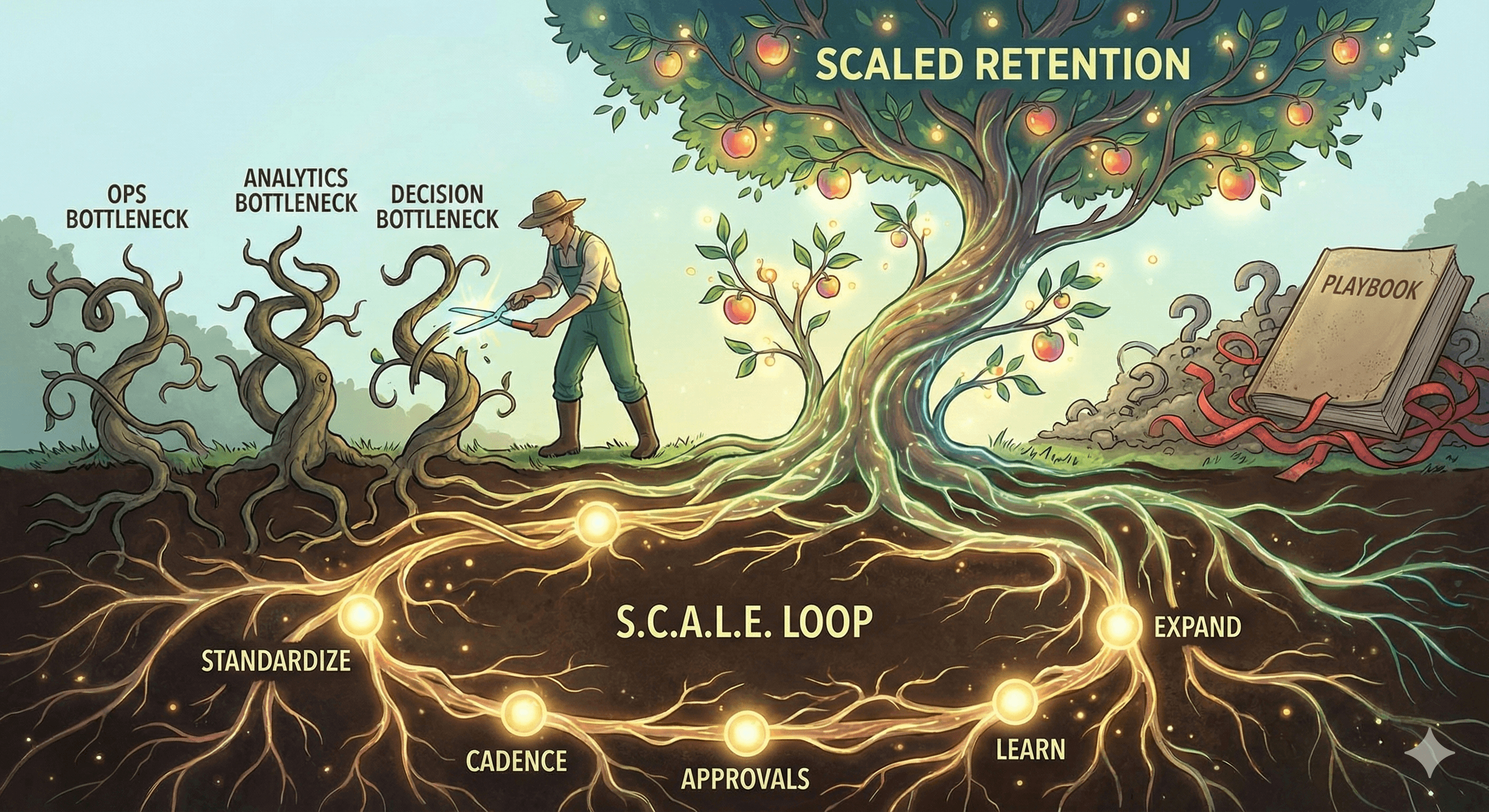
Why: retention experimentation is a factory. Ideas are inputs; tested learnings are outputs. Bottlenecks are what keep you at “two tests per quarter and a prayer.” And the three that matter—almost everywhere—are Ops, Analytics, and Decisions.
What this means in practice: diagnose which one is limiting you right now, then treat it like an operational incident. Fix the bottleneck, not the symptoms.
Let’s make them memorable:
1) The Ops bottleneck (shipping capacity)
Why: you can’t launch faster than your ability to build, QA, configure eligibility, and execute across channels. Channel constraints (email/SMS/in-app), cancel-flow logic, and eligibility complexity create hidden drag.
What this means in practice: if every new offer requires bespoke rules and manual QA, you will never scale—period.
2) The Analytics bottleneck (trustworthy readouts)
Why: measurement, attribution, and readout consistency collapse as you add segments and variants. Without clean baselines and holdouts, you spend weeks debating what happened instead of learning.
What this means in practice: if your post-test meeting is 80% arguing about metrics, you’re capped.
3) The Decision bottleneck (alignment + risk)
Why: stakeholder approvals, risk tolerance, and unclear guardrails create “decision debt.” Tests stall in Slack threads, or worse, get watered down into discounts because discounts feel safe.
What this means in practice: if launching a test requires five approvals and a moral philosophy debate, your roadmap becomes a graveyard.
Upsides you might be overlooking
Here’s the counterintuitive part: you don’t scale by adding people first. You scale by removing choice and variability from the process.
Why: variability is expensive. Every “special case” in eligibility, every custom readout, every one-off approval path turns testing into bespoke consulting work. Mature teams standardize the boring stuff so they can be creative where it matters—the hypothesis and the offer.
What this means in practice: your goal is to make 70% of tests “boring to ship.” Boring is beautiful when it compounds.
A good operator reminder from experimentation research:
“If you don’t have reliable metrics, you can’t trust your experiment results.” — Ron Kohavi, Microsoft/LinkedIn experimentation leader (Trustworthy Online Controlled Experiments)
The formula/framework for scaling tests without chaos
Use the S.C.A.L.E. Loop: Standardize → Cadence → Approvals → Learn → Expand.
Why: scaling is procedural before it’s technical. This loop forces you to build the rails that make volume possible.
What this means in practice: run it like this.
Standardize: Define experiment templates, segment definitions, and offer “families.”
Tactics: create 3–5 reusable offer types; predefine success metrics; lock segment naming; keep eligibility rules modular.
Cadence: Calendarize experiments and reviews.
Tactics: ship weekly/biweekly batches; set a fixed readout meeting; timebox analysis; publish short post-mortems.
Approvals: Pre-approve guardrails so tests don’t stall.
Tactics: set max discount, exposure caps, exclusions, and frequency rules; align on “safe to run” criteria; document it once.
Learn: Produce consistent readouts that answer “what changed” and “for whom.”
Tactics: require a two-sentence summary; track segment deltas; log surprises; don’t let readouts become essays.
Expand: Scale winners carefully; kill losers quickly.
Tactics: expand by cohort, not globally; enforce cooldowns; measure next-cycle behavior; watch for dependency.
False solutions (what teams try that doesn’t work)
More dashboards don’t increase throughput. They increase arguing.
Why: dashboards are visibility, not velocity. One-off deep dives create local clarity and global inconsistency. Ad-hoc brainstorming creates idea debt. “Just hire an analyst” often adds a new dependency instead of removing the bottleneck.
What this means in practice: if your testing volume is capped, the fix is almost never “more insight.” It’s a tighter production system.
What mature teams do differently
They run experimentation like a portfolio, not a series of heroic one-offs.
Why: portfolios force tradeoffs and standardization. Mature teams batch similar tests, reuse templates, and build a segment-based experimentation system where each segment has a plan… not random acts of optimization. They also write consistent post-mortems and turn them into living playbooks.
What this means in practice: if a test doesn’t generate a reusable learning artifact, it’s just a revenue event.
Here’s a quick self-assessment rubric you can run in five minutes:
Ops bottleneck: Do launches constantly slip because eligibility/channel setup is messy?
Analytics bottleneck: Do you debate results more than you act on them?
Decision bottleneck: Do tests die in approvals or get “discounted” into safety?
Score yourself 0–2 on each: 0 = fine, 1 = sometimes, 2 = constant pain. Your highest score is your constraint. Fix that first. If you try to fix all three at once, you’ll fix none. (Ask me how I know.)
Do this next
Pick one bottleneck (Ops, Analytics, or Decision) and write it at the top of your next experiment doc.
Create one standardized experiment template (hypothesis, segment, guardrails, metrics, readout format).
Pre-approve guardrails with stakeholders (max discount, eligibility rules, exposure caps, frequency).
Calendarize a recurring experiment cadence and a readout meeting with a hard timebox.
Add a small holdout for every major test so you can trust the direction.
Publish a two-sentence post-mortem after every test and archive it as a playbook.
Track “experiments per segment per month” as your scaling KPI.
Scaling retention testing isn’t about grinding harder. It’s about building rails that make more learning cheap.